Category Archives: Class Notes

More on Ethos

Here’s some more thoughts/explanations/examples on ethos, which I wrote after my students last semester asked for more resources.

Ethos

Ethos is the credibility/reliability/trustworthiness (or PERCEIVED credibility/reliability/trustworthiness) of the speaker.

The story of “The Boy Who Cried Wolf” is a fable about ethos. Because the boy cries “Wolf!” even when there is no wolf so many times, the villagers don’t believe him when there actually is a wolf. He ruined his ethos by lying and pranking them.

In professional settings, I often don’t have a lot of ethos, because I’m young and don’t have my PhD (yet!!). So in order to convince people that I know what I’m talking about, I may choose to dress extra professionally, talk extra formally, or make a point of mentioning the experience and qualifications that I do have. Think about a resume– that’s a genre that basically only uses ethos. It’s just a list of all the things you’ve done that make you good for a job.

Trump and Ethos

Trump is an interesting person to analyze when we think about ethos. During the 2016 election, and again now, many people who supported Trump said they liked him because he was a successful businessman, so he knows how to run things. Trump’s reputation as a rich person (and owner of a business) made some people trust/believe that he would be a good president.

People who didn’t like Trump would say, “But he has no experience in politics” or “Running a business is different from running a government, so that doesn’t matter.” They did not feel like he had a lot of ethos.

Now, people who don’t like Trump will say, “He lies all the time about everything” — he has no ethos! If he lies, why would you trust him about any given piece of information? Trump supporters say that Trump has a lot of ethos, but the media is not reliable– they say the media has no ethos because they are out to get Trump even if it means lying.

Some Other Examples of Ethos

Ethos is often the source of tension in horror movies. For example, in The Invisible Man, a woman’s abusive ex is stalking and continuing to abuse her, but he’s invisible, so nobody believes her.

(Note: Discussion of assault and racism below)

Ethos is also SUPER important in sexual assault cases. Many times, people try to discredit the victim’s ethos– they were drunk, they’re exaggerating, they just want attention or money or to punish the perpetrator, etc. That’s about whether the accuser is trustworthy. But ethos isn’t just about trust– it’s about ethics, or goodness. We see that on the flip side. Often, when people talk about the perpetrator, they portray the perpetrator as wholesome (“just a kid, has his whole life ahead of him”) or normal (“Brock Turner, a star swimmer at Stanford University”), etc. This builds up the perpetrator’s ethos so people are more likely to believe them, or more likely to be lenient.

Racial profiling is also an example of an ethos problem. Because of racism, anyone who isn’t white is often viewed as less trustworthy– having less ethos– than a white person. They didn’t do anything to earn that lack of ethos– it’s just assigned to them by other people. A given action (walking down the street, holding a toy gun, wearing a turban, etc.) that is interpreted as non-threatening when a white person does it becomes rhetorically threatening when a not-white person does it– because the “speaker” (do-er of the action) lacks ethos. In this case, because of racism, not because of anything they did.

Ethos is not about whether or not someone is ACTUALLY saying true information/doing a particular thing. It’s about whether or not their audience PERCEIVES them to be telling the truth/doing a particular thing.

Ethos and Research/Your Writing

Let’s pretend I want to write a scholarly paper about Black Panther and its significance to African American readers. I’ve only seen the movie once, I haven’t read any of the comics, I’m not part of the fandom, I don’t really know much about comics in general or about African American literature in general, and I’m not African American myself. So I have basically no ethos! I can tell you my opinion about Black Panther, but you have no reason to trust my opinion more than anybody else’s.

In contrast, Professor Jonathan Gray (here at John Jay and at the Graduate Center)  could just say his opinion about Black Panther and it would mean a lot, because he has a lot of ethos. He is a professor with a PhD whose specialities are African American literature, pop culture, and comics. He has written books and articles about these topics. He has a lot of knowledge, not only about Black Panther specifically but about related topics in history and culture. He is also personally African American and a comics fan himself, so he can speak from his own personal experience and feelings about Black Panther too.

So one way I could boost my own ethos is by citing Professor Gray. My opinion might not mean much by itself, but if someone with a lot of ethos on this topic like him agrees with me, you might trust my analysis more!

For your research projects, you all will have at least a little knowledge about your topics, but probably not a lot. You are not experts. So you find information written by experts instead. You boost your own ethos by showing that you are filling in the gaps in your knowledge by seeking out reliable information. As a writer, you’re saying, “You can trust me, because I worked really hard to find true information from reliable sources.”
 

Reflections on my ‘This I No Longer Believe’ paper submission…

  • What did I learn about myself? I realized in the process of writing this paper just how therapeutic writing is for me. I knew this was always a tool I had relied on in the past to manage my stress and anxiety, but I kind of fell off of the wagon so to speak. Formerly, I was quite diligent with keeping a journal. After writing this paper, I think I might make it a point to return to journaling. This might be what is lacking in managing the chaos in my day to day life at this point!
  • What did I learn about writing? I learned that writing can be messy- AND THAT IS OKAY! Re-reading and revising drafts, gaining feedback from peers, and taking time to reflect is SO important. Perfectionism is a myth. It does not exist. I think we could all do with putting a little less pressure on ourselves…
  • What was easy, what was hard? What was new/different? The easy part for me was deciding what I wanted to write about. As soon as this topic of our first assignment was given, I instinctively knew what I wanted to write about. The difficult part for me was trying to nail down getting my points across as to what information I specifically learned that shaped why my viewpoint changed. It is hard to not get emotional about traumatic things that have happened in our lives, and it is hard to prevent those emotions from taking over when presenting information. Also, as per the usual struggle for me- writers block happens! Sometimes you just need to take that break and stretch,  grab a coffee, go on a short walk, and then re-visit the work.
  • What did I gain from the assignment, or what did I hope to gain but didn’t? Not to sound cheesy, but writing this paper gave me so much strength and courage- and that is exactly what I had hoped to gain from this assignment. I chose my topic for this assignment knowing that it would be difficult for me to tell the story, but also feeling that this was a necessary story to tell. There wasn’t a particular aspect of my writing that I had hoped to improve on, because I do feel that creative non-fiction is a strong style for me. However, this writing journey was more emotionally eye-opening than anything else.  Additionally, I learned that I spend so much time worrying about grammar (which evidently I don’t really have an issue with?) while all along I do struggle with verb tenses! This paper highlighted that weakness for me, and it is definitely something I will be working on moving forward.
  • What additional support would have been helpful for me? I would have liked to review more exemplary samples of previous students work with our class prior to doing this assignment.
  • How do I think our peer review process went? What should we change for next time? Overall, I would say the peer review process went well. I think everyone was able to work in whatever capacity they were comfortable in, which is important. However, I do think that next time we should consider the following: Initially, reading multiple students papers and providing feedback proved to be a useful tool; but I feel it would be more beneficial if during the second round of peer review we worked specifically with ONE students work (again, in whatever capacity each person is comfortable with). I feel like there was not enough time to give sufficient feedback to multiple people, especially as the papers grew more in depth. I think it would be a more beneficial experience if, for the second round of peer review, everyone was assigned ONE specific paper to focus on. 

Wednesday 3/4: The Rhetorical Triangle

Writing Into The Day

Find a memory of an argument involving a child and an adult. Maybe it’s an argument you got into as a child, or an argument you’ve had with a child you know (your child, a sibling, a niece/nephew/cousin, etc.), or an argument you observed between a child and someone else.

Using the principles in the reading for today, what advice would you give to the child on how to improve their argument, given the situation and their relationship to each other? What advice would you give to the adult? What could each person have done to persuade the other effectively?

Sharing/Discussion

Overview

  • Ways to participate reminders, checking in
  • Final drafts due!!!
  • Reflections on final paper
  • Intro to the Rhetorical Triangle
  • Looking Ahead

Reminders

  • Spring Start Workshops!
  • March Writing Center Workshops
  • Rhetorical Devices homework!! Participation in this is dropping.
  • Many ways to participate! Consider: writing a reflection on a reading, taking notes in class and posting them to the blog, completing all activities on the lesson plan (and sending them to me) for days you are absent, posting things related to our class in the Optional section.

Final Drafts Due TODAY: Turning Draft In On Time = 5 Points of Your Grade

Reflections on Final Paper

  • What did you learn about yourself?
  • What did you learn about writing?
  • What was easy, what was hard? What was new/different?
  • What did you gain from the assignment, or what did you hope to gain but didn’t?
  • What additional support would have been helpful for you?
  • How do you think our peer review process went? What should we change for next time?

The Rhetorical Triangle

Prezi Here: https://prezi.com/efmzivxn8ecr/?utm_campaign=share&utm_medium=copy

Looking Ahead

March 9 (Monday): Domains of Rhetoric

Readings Due:

“The Romantic Appeal”
“The Gender Appeal”
“The Sex Appeal”
“Predictive Policing”
“The Problem With Broken Windows”

Assignments Due: None!

March 11 (Wednesday): Rhetorical Analysis

Readings Due

“Are Workplace Personality Tests Fair?”
Optional: Take the Five Factor Personality TestMyers-Briggs Test, or another psychometric test and research what this “means” for you as an employee (THIS IS ONLY FOR FUN and has no bearing on what career you should pursue). Post about what you found! (If you want to.)

Assignments Due:

Romantic, Gender, and Sex Appeal Examples
Analysis of an Ad Original Posts Due

3/2 (Monday): Targeted Advertising + Playing with Genre, Style, and Audience Day 2

REMINDER: MEETING IN COMPUTER LAB–  NEW BUILDING ROOM 7.68

Writing Into the Day

Last week, we played with telling our creative nonfiction stories in different styles. Today, we’re going to do the same with Genres and Audiences! Please come grab an Audience slip from me, and begin rewriting your story again for the particular audience you got.

After 5 minutes or so, I’ll ask you to switch with someone near you and do it again, and then we’ll have optional sharing.

Notice how changing your audience also changes your style. How did you tell your story differently, with a new audience (not me) in mind?

Sharing

Overview:

  • Reminders and checking in (spring start, rhetorical devices homework, Testimonial, final drafts)
  • Talking about genre/playing with genre activity
  • Targeted advertising discussion
  • Exploring the Facebook Ad Library
  • Looking Ahead

Genre!

Same activity as with Style and Audience, but with genre cards

Targeted Advertising

Target article: https://www.forbes.com/sites/kashmirhill/2012/02/16/how-target-figured-out-a-teen-girl-was-pregnant-before-her-father-did/#37223a6c6668

(Discuss together but also look at redirect cycle)

Facebook Ad Library

  1. Go to the Facebook Ad Library! (No account necessary)
  2. Spend some time experimenting and exploring. Type in some key words you’re curious about. See what comes up.
  3. Do you see what appear to be duplicates? That’s A/B advertising! (Companies create two very similar versions of the same ad and circulate both to see which one does better)
  4. Choose a search that you’ve found the most interesting. (For example, when I was playing with the library, I stopped and looked more closely at Joe Biden ads.)
  5. Look at the various ads in that search. Are they sponsored by the same organizations? What similarities and differences do you see? What do you think the effects of those differences might be? (I found a bunch that are essentially the same ad, but with the text phrased slightly differently. Which one do you think would be more effective, and why?)
  6. Click on “See Ad Details” for a couple of ads.
  7. Compare the “Seen By” data and the location data, as well as the funding information. What do you notice? What is surprising you?
  8. What do you think the specific goals of the ads are (so, not just “get people to vote for Joe Biden,” but “get elderly men in California to vote for Joe Biden because Super Tuesday is tomorrow and he thinks he could do well with that demographic”)?
  9. Do you think they are effective in those goals? Why or why not?
  10. If you use Facebook or Instagram (they are owned by the same company and share data), what ads from the database have you been seeing? What information do you think the campaigns used to target you?
  11. Post your answers to the blog, or as a comment on this post! Then continue to explore.

Looking Ahead

March 4 (Wednesday): The Rhetorical Triangle

Readings Due
“How To Teach a Child to Argue” 

Assignments Due
Testimonial Examples
“This I No Longer Believe” Final Draft

2/26 (Wednesday): Peer Review Day 2

Writing Into the Day (15 min) (I will collect this one!)

  1. Grab a rubric and your draft and grade yourself!

BE HONEST. This will not affect your real grade in any way, and you will not be required to share it with anyone except me.

The purposes of this exercise are: 1) for you to practice evaluating writing (an important skill in order to self-edit), 2) for me to evaluate and improve the rubric, and 3) for me to check in with you about how you feel about yourselves as writers.

For the first rubric item, it’s 5 points for turning in your partial draft on time, 5 points for today’s draft, 5 points for your final draft (assume you will turn it in on time), 5 points for participating in peer review last time, and 5 points for participating today. For the other items, exactly how to score/distribute points is up to you. Just do what you think is fair to the assignment requirements and to yourself.

2. Do you feel like the total score for your self-evaluation accurately reflects the quality of your work? Why or why not? What elements of the rubric would you add, take away, or change to make the criteria for evaluation more fair? What does “fair” even mean in this context, anyway?

3. What do you need to do (with regards to your essay) between now and next week in order to improve your self-evaluation?

Plan for Today:

  • Discussing Writing Into the Day
  • Spring Start Workshop Reminder, Rhetorical Devices Reminder
  • Peer Review!
  • Looking Ahead

Looking Ahead:

March 2 (Monday): Playing with Genre, Style, and Audience Day 2

Readings Due

“Testimonial” 
Targeted Advertising

March 4 (Wednesday): The Rhetorical Triangle

Readings Due
“How To Teach a Child to Argue” (PDF)

Assignments Due
Testimonial Examples
“This I No Longer Believe” Final Draft

***Preview Rhetoric Mini-Unit***


Erasmus Activity

  1. Your letter pleased me greatly.
  2. I was greatly pleased by your letter.
  3. Ya letta made my day.
  4. Greatly, your letter pleased me.
  5. The words and the sentences you used in your letter made my whole week much brighter than it was.
  6. Your letter was important to me but I didn’t get your letter.
  7. Your letter made me feel great.
  8. The letter you wrote brought me comfort.
  9. I was fulfilled with the letter.
  10. Greatly was I pleased when I read your letter.
  11. Your words brought me joy.
  12. Oh, your letter? It pleased me greatly.
  13. Your message charmed me.
  14. Thank you for your amazing letter
  15. The deliveryman, when he tried to give me in my hand the letter, it fell out and got wet because of the rain.
  16. I appreciate the effort you put into writing and sending this letter. I enjoyed every single part of it.
  17. Satisfaction; that’s what your words provided me.
  18. I was very satisfied reading your letter.
  19. The letter you sent me was very much pleasant.
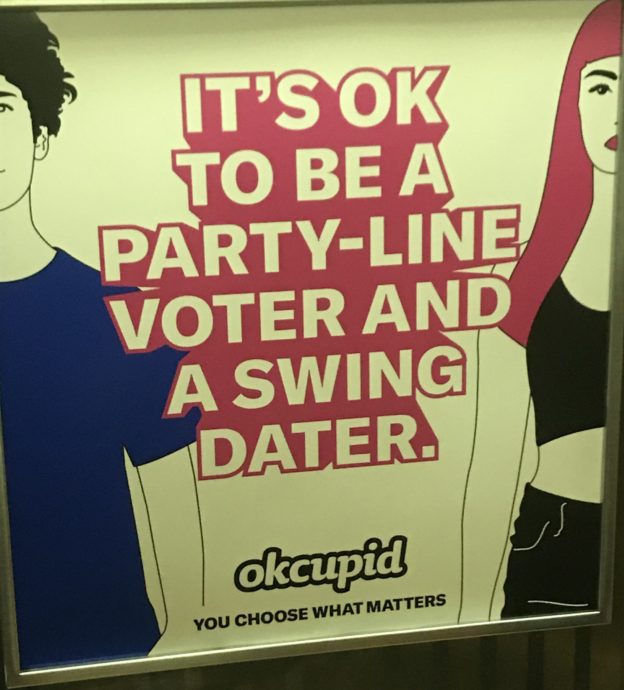
OK Cupid ad showing a masculine figure in a blue shirt and a feminine figure with pink hair, with text reading "Its ok to be a party-line voter and a swing dater."

2/24 (Monday): Playing with Genre, Style, and Audience Day 1

OK Cupid ad showing a masculine figure in a blue shirt and a feminine figure with pink hair, with text reading "Its ok to be a party-line voter and a swing dater." Writing Into The Day (15 minutes)

  1. What argument(s) is this ad making?
  2. What does “swing dater” mean in this context and how do you know?
  3. Who is the intended audience? Why/how do you know?
  4. What strategies is it using to persuade the audience?
  5. Is the ad effective? Why or why not?


Discussion

Overview:

  1. Reminders and Check-In
  2. Writing Activity From 1512!!! (from Professor Desiderius Erasmus)
  3. Writing Activity From 2020 (from me)
  4. Looking Ahead

Reminders and Check-In

  1. Spring Start Workshops!!!
  2. Survey for peer review part 2
  3. New set of rhetorical devices (Fear and Humor Appeals)

Writing Activity from Prof. Desiderius Erasmus (1466-1536)

Erasmus: Medieval scholar who did a lot of translating of the Bible and Islamic philosophy. Wrote De Copia, which is literally the book “on style.”

Your Task (10 minutes):

Rewrite the following sentence in as many different ways as possible:
Your letter pleased me greatly.

Discussion/Creation of Group List

Erasmus Link (Please don’t look at this link before we do the activity!!)

Writing Activity 2 (from me)


Looking Ahead

February 26 (Wednesday): Writing Workshop

Assignments Due
Fear and Humor Appeal Examples
“This I No Longer Believe” Full First Draft Due by the start of class time!!!


2/19 (Wednesday): Writing Workshop 1

  1.  Please grab your name plate as you come in
  2. If you have not already done so, fill out the peer review survey here: https://tinyurl.com/vfbtqr3
  3. And upload your draft to the submission link on Blackboard.

Writing Into the Day

  1. What have you accomplished so far in your drafting process?
  2. What questions, difficulties, or “sticky spots” are you having?
  3. Where do you see your draft going in the future?
  4. What aspects of your writing would you like feedback on at this stage? What aspects do you NOT want feedback on at this stage?
  5. If you have participated in peer review in the past, what was helpful, what was unhelpful, and why?

If you are participating in online feedback and would like to anonymously share the answers to 2 and 4 with your reviewers, please email them to me so I can add them to the corresponding post. 

Overview:

  1. Reminders and Review
  2. Discussing peer review practices
  3. Sorting people who didn’t fill out the survey into feedback groups
  4. Peer review!
  5. Looking Ahead

Reminders and Review

  1. Spring Start– less than half of you attended the first workshop!!!
  2. How to Post refresher
  3. Several past assignments now that you can still do late for partial credit
  4. Post your own optional posts to the blog!

Group Sorting

If you opted for in-person peer review with discussion:

You are in a group together.

If you opted for private feedback from me OR anonymous online feedback:

You will all be commenting on the drafts posted anonymously to the blog.

Leave comments on as many of the drafts as you have time for, but I would rather you spend time leaving thoughtful, detailed feedback on one draft rather than speed through multiple drafts. (Note: In-line comments feature is available!)

If you opted for anonymous in-person peer review:

Please choose whether you would prefer online anonymous feedback or to join the not-anonymous group. Not enough people chose this option for them to remain anonymous while also giving/receiving feedback in real life.

If you still have not chosen an option but do have a draft ready for today:

Choose an option now and either email me your draft so I can put it on the blog anonymously or join up with others who would like in-person discussion.

If you did not choose an option and have no draft ready for today:

Please leave feedback for your classmates online.

Peer Review Guidelines:

I will keep a timer running so we can try to distribute our feedback evenly/make sure everyone gets comments.

Here are some questions for you to think about as you write your responses to your peers.

  1. Summarize the journey the writer is conveying and the major steps along that journey/their significance for the writer. Writers: Do these summaries match what you were trying to express?
  2. Make a comment on some vivid imagery or specific details that you found moving/powerful/effective
  3. Make a comment on some imagery or details that you want to know more about, or you think could be made more specific/evocative
  4. What questions do you have as a reader? (This can be things you found vague/confusing or just things you want to know more about)
  5. Where is the “center of gravity” of this draft so far? (That is, what seems to be the most important part?)
  6. Look back at the rubric/assignment sheet. Do you think there are any specific areas of the rubric the writer could improve on?
  7. If the writer has provided specific questions they would like feedback on, please try to address those.

Looking Ahead:

February 24 (Monday): Playing with Genre, Style, and Audience Day 1

Readings Due
“The Fear Appeal”
“The Humor Appeal”

February 26 (Wednesday): Writing Workshop 2

Assignments Due
Fear and Humor Appeal Examples (comment on post on blog)
“This I No Longer Believe” Full First Draft Due

Blog Assignment-Kamilla

I hope Everybody Liked 🙂

enjoy to read 🙂

Two centuries differ from each other in many ways – the current and past XX and XXI centuries. Life dictates its own conditions: its rhythm is accelerated, it is oversaturated with information. The world goes to another level, an incredible amount of new ones is being created. This does not change: careful and reverent attitude towards children; both to their own and to a whole generation of children. Grandparents. Children are the future, everyone knows that. The quality of life in a few years, technological progress, the state of the environment, and the level of medicine depend on how these children will be raised and how much effort will be invested in them. Are there people who are indifferent to the future of their city, state, planet? It is in the interests of everyone to educate a worthy Man, to raise a real citizen, to endow him with important values. Our great-grandfathers thought so, so we now think.The difference between a modern child and children of past generations is noticeable to the naked eye. So why are the children in whom the seemingly equal amount of love and care invested, so different from their peers who lived a century, half a century, or even twenty years ago?

First, consider the reasons for such differences. Undoubtedly, the most important role in them is played by changing living conditions. Today’s children grow up in a completely different, hundreds of times more saturated information field. The modern world provides in abundance information that children can only absorb, without making certain efforts. Indeed, you must agree that in order to raise data on a topic, it is easier to open a page on the Internet than to search through a two-volume reference book, go to a library or visit a museum. So what are they, modern children? The first distinguishing feature that is characteristic of modern children, which I would like to note, is the need for continuous monitoring. In the last century, parents, grandparents, could leave the child in the apartment, reminding him only that the door should not be opened to anyone and should not indulge in matches. They left for half a day in complete confidence that the apartment would remain safe and sound until their return. Now, with the advent of numerous gadgets, expensive equipment, expensive furniture, insecurity and fear of both life and health are inherent in parents child’s health, and for the safety of an expensive leather sofa, new parquet and a plasma TV. Indeed, in our time, children at an early age are unusually smart, act instantly. This allows them to carry destruction with great speed.

Previously, parents, leaving the child in a room with an uncomplicated toy in private, could easily have dinner and talk. Now you need to be in constant direct contact with the child. Otherwise, in the best case, damage to household property is inevitable, and in the worst case, injuries and other unpleasant consequences. Accordingly, in order to avoid problems, parents invite nannies and governesses, or they send their children to special institutions, which in the first and in the second case entails certain consequences, often negative. It is enough to compare the games played by children of different eras. Previously – soft toys, cubes, designers, railways, mosaics, dolls. Now – computer games, cartoons from the Internet or TV, mobile phones, game consoles. And progress regularly equips children with newer and newer “toys.”

The second item on the list of characteristic features of the current generation of children, I would put a constant thirst for attention. This could be attributed to upbringing, politeness and punctuality, but, as the trend is growing, it is rather a “disease” of an entire era, rather than individual families.

Previously, a child on a walk was left to his own devices, could spend hours entertaining himself in the sandbox or near a large puddle, for example, launching boats and spanking in boots on the water. Parents at this time had the opportunity to read the newspaper or spent time talking. Now you rarely see such a picture. A modern child insistently pulls on the sleeve of his mother, who has stopped to talk with a friend, turns around, is naughty, meets in an adult conversation and does her best to draw attention to herself until she receives it. Children of past generations calmly waited for the conversation to end. If you do not pay attention to these antics of modern children, the case may turn into a serious resentment. When today’s children want to share their opinions, they actively draw attention to themselves, shout, cry, do everything to be noticed and allowed to speak. If this fails, they are offended. Another suitable definition for modern children, I consider the word “all-knowing.” They have a radically increased need for information, but also a well-developed ability to perceive and process it. But in children, the choice of the object of study, of course, is limited to the most interesting information. That is, about pirates and, for example, horses, they get an exhaustive amount of data. Television and the Internet instantly provide any information in unlimited quantities. Open access allows you to get any knowledge, you just need to click on a couple of buttons. Nevertheless, it remains to recognize the fact that the worldwide network plays a huge role in raising a modern child. But in this notorious open access to the Internet there are also dangers: the availability of information that threatens the normal psychological and emotional development of the child.

In conclusion, I can say that if we compare the modern preschooler with the children of the sixties of the last century, the differences in world perception, pace of development, behavior and self-awareness become apparent. And it is impossible to apply the approaches and methods that were relevant 20, 30, 40 and 50 years ago in the education of a modern child. Each new generation is unique, and each specific child is unique. The key to success of parents will be an individual approach and attentive attitude to the child.

2/10 (Monday): Beginning Creative Nonfiction

Writing Into the Day (15 min):

Tell the story of your commute to class today, using specific details/imagery. Rather than just describing the route you took, share with us the things you noticed, what those things mean to you, how you felt. Help us envision what it was like to be you.

A Bad Example: I was at the Graduate Center before this, so I walked to Herald Square and took the B train to Columbus Circle and then walked here, picking up a latte on the way. Then I worked in my office for a little bit and then I took the elevator downstairs to come to class.

A Better Example: After my student committee meeting, I left the English department lounge and headed for the elevators. Downstairs, I take my Metro Card out of my wallet in the lobby and then step out into the damp February air. Fuck. I forgot it was going to rain today. Back into the lobby, drop my backpack, take out my umbrella. Back outside. Wish I’d worn a scarf. The homeless man who often sits at the top of the subway entrance with his mirror and basket isn’t here today– I hope he’s somewhere dry. An opera singer is performing on the mezzanine. She’s very good, but I like the man with the didgeridoo better… (And so on)

Sharing?

Overview:

  • Logistical check-in — Are you facing any technical problems or confusions with navigating the Course Site/ course requirements?
  • Spring Start check-in
  • Reading and annotating example of Creative Nonfiction
  • Generate list of guidelines for What Makes This Good?
  • Go over assignment sheet for Paper 1, discuss how we may want to revise the rubric

Looking Ahead:

Wednesday, February 12: NO CLASS

3 readings to do (but I may cancel one of them):

Weapons of Math Destruction: Chapter 3 (PDF)
Article on College Rankings
SAT selling student info

Monday, February 17: NO CLASS

Weapons of Math Destruction Blog Assignment Due (instructions will be posted soon)

Wednesday, February 19

Readings Due
“Shitty First Drafts”

Assignments Due
“This I No Longer Believe” Partial Draft Due
