Class Now Online

Dear Students,

The English department has strongly encouraged faculty to shift all classes to an online format, potentially for the rest of the semester. Certainly until conditions start to improve rather than continuing to get worse. However, online-only learning is certainly different, and we will all need to be patient with ourselves and each other as we adjust and figure out what works best for our class.

Therefore, I want to take some time to explain why I believe social distancing, when possible, is important. I will endeavor to use Aristotle’s 3 appeals and each piece of the rhetorical triangle as I compose this post, so as an exercise to practice, keep an eye out for how I’m considering each one as you read (even if you don’t think I’m being effective in one or more ways).

Many people are saying that concern around COVID-19 (the current strain of coronavirus) is overhyped, and that it’s far less prevalent than the flu. So, why are the changes being implemented around the world important? For one thing, our healthcare system is managing coronavirus on top of the existing flu season (which is already worse than average).  This means that hospitals and other medical facilities have fewer resources with which to help all patients, regardless of their ailment.

Distribution chains are also struggling, since many U.S. products are manufactured in other affected regions like China, and many people are buying up materials like hand sanitizer, alcohol swabs, and masks. Because demand is so high, medical facilities are also facing greater difficulties in acquiring supplies– it’s not just regular people going to CVS. Furthermore, COVID-19 is spreading at an exponential rate, doubling around every 6 days. It is likely to get far more widespread before it goes away.

So, healthcare facilities are at a high risk of being overloaded, and many healthcare facilities already face long wait times and limited space. Another issue is we don’t actually know how widespread the virus is in the U.S., because access to testing kits is limited , and many people cannot afford the medical bills of getting tested (one man’s bill for getting tested was about $1,400 after his health insurance paid for some of the costs) or cannot afford to take the time off of work/care responsibilities to do so.

Some epidemiologists (disease experts) are estimating that eventually, 40-70% of the human population will contract COVID-19. The question becomes, when? That’s where social distancing comes in.

Social distancing essentially means limiting time spent in groups of people, including at work, at school, on the train, and at social events. The goal of social distancing is to flatten the curve — that is, slow the rate at which people are getting the virus. If fewer people are sick at the same time, our healthcare system is better able to handle the situation and take care of everyone, even if the total number of sick people remains the same.

It’s true that the overall fatality rate is fairly low compared to some diseases, but it’s high for some populations of people, such as the elderly and people who are immunocompromised (their immune systems aren’t very strong, so they’re much more vulnerable to illness). And it’s important for us to care about the wellbeing of these people too, even if we ourselves are not at high risk. This is the same principle behind vaccines: herd immunity.  If most people are safe from a virus (either through immunities or through protective measures), fewer people get the virus, and the virus is more easily treated and contained.

The virus also has the potential to seriously affect people economically. For jobs that rely on tips, or people who get paid hourly only when certain institutions are open (schools, for example), people may lose their source(s) of income even though they are still employed. So, it’s extra important to limit the severity of the pandemic as quickly as possible, although I do think that it’s very important for schools/workplaces to consider and provide for how students’/workers’ needs will change, including considering access to technology, access to food and housing, etc. For example, I think the advice from many places to just “not take public transit” is laughably unrealistic, and telling people to stay home without providing for how they will afford to pay their bills is…a major problem.

I will write again later today with a plan for how our particular class will proceed. As I said yesterday, please still do your homework for today, please fill out the technology survey, and I’ll be in touch. Likely we will do a blend of some webconferencing and some asynchronous work. Please also check your email notification settings for this site, since it’s now especially important that you stay up to date with information.

Please email me with anything you’d like to talk about, or ways I can support you further.

Romance, Gender, and Sex Appeal Examples

Romance Appeal 

Example 1: Ralph Lauren Romance TV Commerical, ‘Do You Believe?’ https://www.ispot.tv/ad/IGKk/ralph-lauren-romanance-do-you-believe-song-by-jessie-j

Analysis: This advertisement first aired back in May of 2019 for the release of Ralph Lauren’s new fragrance, Romance. The song featured in the commercial is called ‘Real Love’ by Clean Bandit and Jess Glynne. The clip features a young couple falling in love. There are cliche romantic scenes where the couple is walking through what appears to be a sea of flower petals, and one where they are running and kissing in the rain. At the end of the advertisement the woman introduces the perfume by asking “Do you believe in romance?”. I am not sure how effective an advertisement like this is, because the entire time I am watching the ad I am too busy wondering what the hell is this an advertisement for? It is only at the very end that they disclose that and make it clear. The romance appeal is basically depicted via this picturesque couple, which some people may envy. Ralph Lauren wants you to associate this type of relationship with the use of this fragrance.

Example 2: Sandals Resorts TV Commercial, ‘Who Says?’ https://www.youtube.com/watch?v=1lMxZNFripE

Analysis: Sandals Resorts advertisements are pretty well known for utilizing the romance appeal to draw people in. The particular commercial that I referenced above shows video footage of several couples in seemingly blissful love enjoying the amenities, and beautiful beaches and scenery that this resort has to offer. Even the voice of the woman narrating the commercial is smooth and sweet sounding. Through commercials laid out like this one, Sandals is able to get people to desire this type of romantic getaway. They are illustrating how happy, relaxed, connected, and “in love” their guests feel while staying at their resorts. This type of advertising in my opinion is very effective.  You are viewing all these images of beautiful people, enjoying gorgeous beaches, and luxurious amenities, while simultaneously listening to a soothing voice explain to you why the resort is so wonderful and what the perks of staying at a Sandals resort are.

Gender Appeal

Example 1: Controversial Peleton TV Commercial, ‘The Gift’ https://www.youtube.com/watch?v=ijof8uw4OHs

Analysis: I’m sure everyone recalls the super controversial Peleton commercial that was airing around this past holiday season. The commercial depicts a woman receiving a Peleton bike as a Christmas gift from her husband, and the “personal journey” she takes each day as a result of receiving the bike. Yes, an already seemingly thin woman, receives an exercise bike as a gift for Christmas from her husband- to lose more weight. This ad caught a lot of flack from viewers claiming it was sexist and degrading towards women, and pushing the agenda that sets unrealistic expectations for women’s physique. I do not think Peleton foresaw how negatively this advertisement would be received. I believe that the original intention of this ad was to demonstrate how a woman can play many roles in life, and still find time to take care of herself and exercise to improve her overall well being. In the ad you see that the couple has one child. You also see the mother returning from work and then exercising, and waking up at the crack of dawn to use the bike as well. So this woman is a wife, a mother, an employee etc. and she’s still making time to exercise thanks to the thoughtfulness of her wonderful husband. I think it was meant to appeal to the busy women of the world who strive to “do it all”.

Example 2: Chrysler Pacifica Commercial ‘No Matter How You Parent’ https://www.youtube.com/watch?v=Zy-1JnWGk2c&list=PLVCNuSyxRxgit5N18YFOers7H-DQZKKOH

Analysis: I personally find this commercial hilarious. The commercial depicts two different “types” of moms in the school drop off/pick up line: The mom who is a hot, frazzled, mess that can’t seem to get her sh*t together, and the mom who is seemingly perfect, dressed professional, without a hair out of place. The fact that Chrysler chose to use women to advertise their newest model minivan speaks volumes in itself. It kind of illustrates the typical gender role of a woman: A woman’s purpose in life is to be a mother, and the primary caretaker for her children, therefore she needs a reliable and spacious minivan to schlep them around from place to place. So although the commercial is meant to say “hey, our minivan appeals to you, regardless of what ‘kind’ of mom you are” it nonetheless still resonates with the cliche message that women should be mothers, and therefore they should be driving around in minivans to transport their children.

Sex Appeal

Example 1: Gucci Guilty Perfume Advertisement

Analysis: The first ad I chose that utilizes the sex appeal tactic is this advertisement for Gucci Guilty women’s perfume. The ad displays an attractive man and woman, seemingly naked, embracing with a bottle of the actual perfume depicted in the bottom right corner. In very small font at the bottom you can see the words “The new fragrance for her”. The man in the advertisement looks as if he is smelling the woman’s neck, entirely enchanted by her. The ad is basically projecting how sexually desirable a woman will be if she utilizes this perfume.

Example 2: GoDaddy.co Body Paint 2012 Superbowl Commercial https://m.youtube.com/watch?v=q9ucBY_2WEA 

Analysis: This commercial aired during the 2012 Superbowl. It features former NASCAR driver Danica Patrick and fitness guru Jillian Michaels painting another woman’s naked body with the name of companies that advertise on the GoDaddy website. The advertisement is basically suggesting that if you want your businesses website to get more traffic or clicks, you should consider using GoDaddy as the platform because they know how to grab peoples attention (ex: by painting advertisements on a naked woman’s body). I am unsure of how effective this ad is. I feel like some people may find it offensive or degrading towards women, while on the other hand some may find humor in how ridiculous the ad actually is.


AD Analysis

I am one of those New Yorker’s who constantly finds herself in and out of pharmacies. My mom is sick and must keep herself medicated to minimize pain and other symptoms. A regular visit to the pharmacy consists of me providing whoever is up front with her date of birth (or mine), wait for them to prepare the medicine or just simply wait for them to look for the prepared package, sign and say goodbye if I feel like is necessary. Now, in any of these visits, neither the cashier or I begin a sort of personal conversation or talks about anything other than medicine.

Capsule Pharmacy is the speaker of this ad, they are presenting themselves almost as a safe space. They want us to look at them as someone who is looking to make a change towards ‘pharmacy life’ in a very comical way. You can tell by the way they are trying to approach the desire audience with their words, more in a family way than in a stranger way. This ad in the D train really makes you think, ‘What kind of pharmacist is this? I do not want it. #Creepy.’ This approach is very funny to me, since it would be weird to go to your regular pharmacy, ask for your medicine and once you receive it,  get a nice and sweet “I love you” from the pharmacist. It is just weird and creepy! They are trying to attract those who frequently find themselves on the way to pick up medicine for themselves or for love ones. Currently, many people long for attention and I believe this specific ad is doing that. Telling those whoever encounter it “with capsule you will get the attention you need, and whenever you need it… Also, as weird as you need it.”  Capsule uses the simple and direct language to attract their audience, also they try to pick a certain part of your brain that might make you feel uncomfortable by hearing the words ‘I love you,’ but yet you are paying attention to their message.

Ethos in advertising is to use an appeal to an individual’s moral and character, thus making them think that what they are presenting is trustworthy. Based on this, I do not believe that this advertisement has use ethos to try an engage their audience. Using the
“most likely to hear ‘I love you’ than ‘next please,’” it pushes the audience away from considering the thought that they are trustworthy. However, it depends on the person, because someone might be susceptible to these words, thus, leading them to believe in the well-functioning of this company.   Logos is an appeal to logic; this is something else I do not believe the add has used or introduced properly for the same reason mentioned above. An ‘I love you’ from a stranger and more one in that situation, it is not rational. However, a rhetorical device the ad does use is pathos, the appeal to emotion. By using the word love and what the recipient of the ad might want, they are toying with our emotions and allow us to play it out, considering a situation where this might happen, whether they mean it hypothetically or literally. I believe this ad is effective. I am someone with a wide sense of humor, and curious, too. If I am presented with this advertisement at random, I will not deny I will raise my eyebrows at it, but I will laugh and decide to give it a try. Sometimes you need someone else to take care of your to-do list and this application or system could be it, even if its in an eerie kind-of-way.


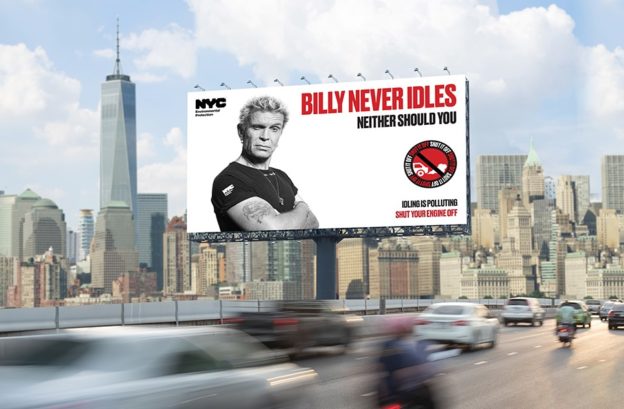
Analysis of an Ad- “Billy never idles, neither should you.” DEP’s new anti-idling campaign

The advertisement I chose for our ‘Analysis of an Ad’ assignment is a billboard that was recently introduced as a part of the New York City Department of Environmental Protection’s (DEP’s) anti-idling campaign. This billboard debuted itself as a part of my daily commute on the Brooklyn-Queens Expressway (full disclosure: I went and looked up the advertisement online after I noticed it, as I did not want to use my cellphone to take a photograph while driving!).

The advertisement features a photograph of popular English musician Billy Idol, and displays a catchy play-on-words technique via his last name: “Billy never idles, neither should you.” There is also a sort of “badge”, that illustrates a vehicle with exhaust fumes emitting from it and a slash through it, repeatedly surrounded by the words “SHUT IT OFF”. To further drive home the point of the ad, the words “Idling is polluting, shut your engine off” are displayed below the badge.

There are two speakers in this ad; the DEP and Billy Idol. They are trying to present themselves as authoritarian, while clever. There are several indicators of this. First and foremost, I noticed that the text throughout the entire ad is capitalized and in a bold font. Most times, when receiving an e-mail or text message in entirely capitalized font, the recipient would assume that the sender is angry or feels very strongly about what they are trying to say. The color scheme of the entire ad is also very telling; specifically, the use of the color red. When I noticed the phrases written in red, my mind immediately went to “stop” or “no”. Drivers, the targeted audience, may associate the color red with traffic lights or even stop signs. Hence why the use of this color in the display is effective. The use of the word “never” in this ad also conveys the seriousness of this issue; they could’ve easily used the words “Billy does not idle, neither should you”, but that wouldn’t have been nearly as effective in expressing the importance of their message.

The ad is trying to convey to the viewer that as per the NYC DEP idling your vehicle is bad for the environment. Therefore, it’s safe to infer that the advertisement is basically intended for anybody who owns or operates a vehicle within the five boroughs. I immediately observed a few strategic uses to persuade the audience. The most noticeable technique employed, in my opinion, is the bandwagoning technique. It is illustrated point blank in the ad by almost literally saying “Billy Idol doesn’t do this because it’s bad so you shouldn’t do it either”.  Additionally, I feel like the ad utilizes a testimonial appeal tactic via Billy Idol’s celebrity endorsement. By showing the audience that Mr. Idol stands behind this environmental cause, it is hoping to strengthen peoples’ belief or understanding that idling their car is bad for the environment. This raises the question for me though: how much does Billy Idol the famous musician really know about environmental dangers?

In terms of appealing to the three components of the rhetorical triangle, I am not positive that this advertisement effectively satisfies all of them. When it comes to Ethos, the identity and credibility of the speaker(s) is (are) questionable. On one hand, you have the DEP- an established and credible New York City agency, comprised of individuals well-versed on preserving the environment. On the other hand, you have celebrity Billy Idol- who is extremely successful and wealthy, but really does not have much of a background or an affiliation with preserving the environment. I feel as though credibility may come into question there.

Additionally, the advertisement relies on the assumption that the audience knows who Billy Idol is. Realistically drivers in NYC are eligible to acquire their licenses at the age of eighteen. These individuals were not even born yet when Billy Idol was at the peak of his musical career and a major influence in popular culture. This presents the following questions: do they even know who Billy Idol is or understand the wit of the catchphrase used here?

Logos appears to be absent altogether from this advertisement. Statistics, data, facts, logical reasoning etc. as to why idling is bad for the environment are nowhere to be found in this display.  When it comes to Pathos, I do not believe that the advertisement packs a major punch in the emotional department either. Does the audience feel Billy Idols distaste for idling vehicles based on his facial expression in the advertisement? Perhaps it does, however I do not see this advertisement playing on people’s emotions to get them to appeal to the message that is being conveyed. If there were photographs in the background of nature decaying as a result of the pollution from car emissions, maybe some emotion would be evoked from this advertisement.

Overall, I do not feel that this advertisement is effective. It is void of any type of logical data or statistics to persuade the viewer or present a valid argument for the message it is trying to convey. It also relies on the assumption that the focus audience knows who Billy Idol is. Personally, looking at the ad it did not spark any emotions for me. I recall noticing the advertisement and thinking to myself “oh look its Billy Idol I wonder what he’s been up to these days?”, because he really is irrelevant in popular culture, and I have not seen him much in the mainstream media. I was not even focused on the message of the advertisement. I will say that it does effectively use language via the play-on-words with the endorsers last name, but that is about all I feel this ad accomplished.

For a better photograph of the advertisement, and for more information on DEP’s anti-idling campaign, you can visit: https://www1.nyc.gov/site/dep/whats-new/billy-never-idles.page?utm_source=Search&gclid=EAIaIQobChMIoeCL1vmP6AIVA4NaBR2luQBBEAAYASAAEgJkGfD_BwE

Survey About Home Technology

CUNY has offered a list of “Things to Do Now” to prepare for the possibility of having to shift all classes to an online format, as some schools around the U.S. (and the world) are currently doing.

One of those things is to figure out what technology our classes have easy access to at home, so we can plan appropriate activities. (For example, some things like watching videos can take up a lot of bandwidth/cellular data, and that might not be feasible for you. If most people can watch videos at home with no problem, I might make videos but also provide text versions of the same information for those with limited data. If most people cannot easily watch online videos at home, it wouldn’t make sense for me to make them.)

This form is ANONYMOUS. Please fill it out as soon as you can, so I can make sure to plan lessons that are useful/accessible to our class community.

Technology Access/Needs Survey

A survey to gauge students' access to different technologies at home in order to plan activities for online learning that everyone can participate in.

Romance, Gender, and Sex Appeal

It seems that the site I wanted you to read about these appeals is down–or at least, that part of the site. However, I still want to do this exercise, since these 3 appeals are EVERYWHERE (and not just in advertising– in everyday conversations). So, I’m just going to write a little explanation of each one.

For each appeal, please provide 2 examples, the context of each example, and an analysis of each example, in the comments on this post. Due by Wednesday 3/11 at 4:30 pm.

Romance Appeal

Romance appeal is one way to use pathos. When we appeal to the idea of romance, we’re utilizing the fact that most people desire some kind of romantic love. Think of commercials that feature couples staring lovingly at each other while using the product (like most jewelry commercials), or that feature someone asking another person out and having them say yes. Romance appeal also applies to any argument that carries the assumption that you ought to desire a romantic relationship, or subscribe to particular standards of what a “good/ideal” romantic relationship is.

Gender Appeal

There are many ways to be masculine, many ways to be feminine, and many ways to be androgynous. Rhetoric that uses gender appeals both plays on people’s desires to embody a particular variation of their gender and creates arguments about what “correct” behaviors for that gender are.

For example, an Axe Deodorant commercial might show a man doing physical labor things, might include a voiceover with a deep voice, etc. A Dove soap commercial might show a woman taking a luxurious bubble bath and shaving her legs.

Both of these examples say, “[Doing physical labor/spending a lot of time on personal grooming and shaving body hair] is the right way to be a [man/woman], and this product will help you do that.” Children might learn messages about what toys are appropriate for boys and what toys are for girls by who they see playing with what toys in commercials.

Gender appeal doesn’t have to always be about negative stereotypes, though. What about commercials that show women getting awards, or men being loving dads? These are saying “women can achieve big,” and “a good man spends time taking care of his kids.” You can ask yourself, does the gender of the person seem to matter to the power of the message, or is it incidental?

Outside of advertising, any gendered message like “Boys don’t cry” or “X isn’t ladylike” is using the gender appeal. It’s using your identity as someone with that gender to persuade you to do/not do a certain thing.

Sex Appeal

This one is probably the easiest. Is the message designed to be erotic, to arouse the audience? Or to say, “you will be sexually desirable if you do X”? Then it’s sex appeal. Hardees commercials often use sex appeal.

3/9 (Monday): Domains of Rhetoric

While we are writing, I’ll be getting Zoom set up and helping those who are joining us digitally to troubleshoot any technical problems.

Writing Into the Day (15 mins)

(Current version includes student responses to questions and main ideas from class discussion)

  1. What questions did the readings about predictive policing raise for you today? Is there anything you would like to discuss as a group?
    1. If the software predicted white collar crime, would it be considered more fair, and ought police focus on that, rather than keeping their neighborhoods safe from immediate threats?
      1. Isn’t credit card fraud protection software also/already doing this?
      2. Maybe leave white collar crime to feds
      3. If we say “Chicago has the highest murder rate, are we saying that the police are turning a blind eye to murders in other areas?”
      4. Murder rate = people who are CHARGED with murder (we think)
        1. What about cold cases?
      5. Marissa recommends “Citizens” app, crowd sourcing crimes– different people report different things. Anxiety-inducing! Police not involved (formally, some may watch the app individually) with the app. Crimes that are reported may or may not even be real
      6. Destiny asks, what makes something count as a “bad neighborhood”?
    2. By putting a number on a person for risk of recidivism, doesn’t that defeat the premise of “person commits crime, person pays for crime via sentencing, person has paid their dues”?
      1. Scoring based on hypothetical potential for crimes can lead to discrimination against people who haven’t done anything wrong, or might lead people to be like “well, everyone thinks I’m a criminal and treats me like that anyway, may as well commit crimes”
      2. Somewhere in Florida, there’s a town of sex offenders, “Miracle Village,” religious community, because they’re not allowed to live elsewhere, they’re largely self-sufficient and crime is apparently very low there. Also very minimal policing
        1. Maybe this is an example of people knowing they did wrong and wanting to improve– this would be contrary to the idea that people who commit crimes are more likely to do more crimes in the future
        2. Gated community based on religion? Maybe this is why crime rate is low? Or maybe they don’t commit crimes there? Or maybe strong community bond = less crime.
  2. What are some of the consequences (intended or unintended) of assigning people a score predicting how likely they are to commit a crime in the future?
  3. How should communities change their strategies toward crime prevention in order to be more fair?
    1. “Does gentrification reduce crime?” (study, will attach link later) research by Policy Cebr , largely based on government data. There is a correlation between gentrification and less crime.
      1. Gentrification doesn’t REDUCE crime, it MOVES the crime to other neighborhoods

Sharing/Planning Discussion

Overview:

  1. Checking in
  2. Doing whatever we decided to do w/r/t discussing the readings
  3. Domains of Rhetoric Powerpoint
  4. Looking Ahead

Domains of Rhetoric Powerpoint

Looking Ahead

March 11 (Wednesday): Rhetorical Analysis

Readings Due

“Are Workplace Personality Tests Fair?”
Optional: Take the Five Factor Personality TestMyers-Briggs Test, or another psychometric test and research what this “means” for you as an employee (THIS IS ONLY FOR FUN and has no bearing on what career you should pursue)

Assignments Due:

Romantic, Gender, and Sex Appeal Examples
Analysis of an Ad Original Posts Due

March 16 (Monday): Beginning the Final Project

Readings Due:

“The Snob Appeal”
“The Youth Appeal”
“Working Anything But 9-to-5”
“Leading Mathematician Debunks Value Added”

Assignments Due:
Analysis of an Ad Responses

March 18 (Wednesday): Proposal Sharing and Revision

Assignments Due:
Snob Appeal and Youth Appeal Examples
Proposals for Final Project Due

Fear and Humor Appeal Examples

Fear Appeal
Example 1: “Smoking Kills” : https://twitter.com/tobaccopoison/status/915146927326580736

This particular advertisement was originally released by the organization ” the truth”. Some people may be familiar with their advertisements that appear on networks such as MTV. Their ad’s generally focus on major issues impacting our communities like addiction, smoking, environmental awareness etc. This ad, which was tweeted by the account Smoking Kills, depicts what appears to be a dead body on a table, most likely in a coroners office. All you can see is the bottom of the individuals feet with an ID tag looped around a toe. The tag reads “smoking kills” and the backdrop design of it appears to be the same design as a Marlboro carton of cigarettes. The top of the ad also features information on the statistics of how many Americans die each year from smoking related diseases along with what percentage of these individuals started smoking in their teen years.  From this, we can infer that this advertisement is targeted at younger individuals, in an effort to scare them into not smoking. Basically the ad is implying that yes you are young now, so maybe smoking won’t affect you as drastically as a teen, but ultimately we all end up down the same road if we start smoking: dead.


Example 2: “Was That Text Worth It?”:

Texting and driving is another topic that we often come across advertisements utilizing the fear appeal strategy. Depicted here we see a young girl laid out on what appears to be the medical examiners table in a dimly lit room. In this particular ad, you notice the utilization of slang in the wording of the ad and the emoji face placed over the victims face, both done perhaps to appeal to a younger audience or imply that young kids do the majority of texting and driving (even though plenty of adults are just as guilty of this too!). The message is very simple: Don’t text and drive, because it is not worth risking your life.

Humor Appeal

Example 1: Audi vs BMW

Funny Car Ads

Here we have comedic billboards pitting two popular, long-standing, car manufacturing rivals in the European car market against one another. The first ad featuring the Audi A4 essentially calls out BMW by showcasing their latest and greatest sedan stating “Your move, BMW.”. The second ad, featuring the new BMW M3, is BMW’s sarcastic reply “Checkmate”, a term that is utilized in the game of chess when you are declaring you are capturing your opponents King piece and winning the game. BMW is basically implying that their new model M3 is superior to the new Audi A4 (which in my opinion is true!). The issue with these ad’s is that they definitely do not appeal to everyone. As a car enthusiast I find it hilarious, but somebody who is not into cars, or doesn’t understand the rivalry between these two manufacturers may not understand the advertising strategy or find this humorous. I did notice that in the advertisement for Audi in the bottom left-hand corner the website is advertised, whereas in the ad for BMW, the location and website for the dealership that paid for this ad are specifically listed.

Example 2: Dentastix

This advertisement for Dentastix depicts what looks like a basset hound, drooling over a bird in a bird cage. The bird appears to be passed out/dead from the stench of the dogs breath. The wording reads “against bad breath”. I am on the fence about whether or not this is an effective ad. It is humorous and could appeal to a large group of people (dog lovers, animal lovers etc.). I mean just look at how cute that dog is!? However, it does not give much detail on what exactly the product is. It may prompt somebody to look up exactly what Dentastix are, but the ad itself isn’t very specific. As a dog owner, I am familiar with the product; but not everybody is a dog owner. Additionally, they could’ve done something like list the benefits or the ingredients, or what exactly makes their product so effective.

More on Pathos

** My students last semester also asked me to write more about Pathos. I didn’t write anything about Logos. If you would like me to also write some more about Logos, let me know in a comment! ***

Pathos is all about appealing to people’s emotions. A commercial featuring sad puppies (ASPCA), or cute babies (some cleaning products, all baby products), or young adults having fun (Coca Cola) is trying to get you to buy the product (or donate money) by associating that act with the emotion that the commercial gives you. You want the puppies to have homes and be loved, don’t you???

People who are asking for money/food/other resources on the street or on the train usually use pathos as their main rhetorical strategy. They often appeal to our sense of moral decency and empathy for other human beings. Or perhaps our sense of guilt for not helping others when we probably could.

Mattress and bedding ads appeal to pathos! Because nice new fancy sheets that probably smell nice make you think of being in your cozy bed…how nice would that be? Wouldn’t you like to be in bed right now? Pathos.

Calls for political action often appeal to pathos, because they call out something horrible in society to make you angry and then ask you to (donate, vote, volunteer, etc) as a way of dealing with that anger.

Sex appeal is also pathos. You want to be sexy, or be with someone who is sexy, or do sexual things, and this product will help to be sexy/attract sexy people/help you have sex! All of that is based on feelings.

Nostalgia is also pathos. We especially see a lot more ads appealing to nostalgia as we get closer to Thanksgiving and Christmas.