Category Archives: Lesson Plans

3/2 (Monday): Targeted Advertising + Playing with Genre, Style, and Audience Day 2

REMINDER: MEETING IN COMPUTER LAB–  NEW BUILDING ROOM 7.68

Writing Into the Day

Last week, we played with telling our creative nonfiction stories in different styles. Today, we’re going to do the same with Genres and Audiences! Please come grab an Audience slip from me, and begin rewriting your story again for the particular audience you got.

After 5 minutes or so, I’ll ask you to switch with someone near you and do it again, and then we’ll have optional sharing.

Notice how changing your audience also changes your style. How did you tell your story differently, with a new audience (not me) in mind?

Sharing

Overview:

  • Reminders and checking in (spring start, rhetorical devices homework, Testimonial, final drafts)
  • Talking about genre/playing with genre activity
  • Targeted advertising discussion
  • Exploring the Facebook Ad Library
  • Looking Ahead

Genre!

Same activity as with Style and Audience, but with genre cards

Targeted Advertising

Target article: https://www.forbes.com/sites/kashmirhill/2012/02/16/how-target-figured-out-a-teen-girl-was-pregnant-before-her-father-did/#37223a6c6668

(Discuss together but also look at redirect cycle)

Facebook Ad Library

  1. Go to the Facebook Ad Library! (No account necessary)
  2. Spend some time experimenting and exploring. Type in some key words you’re curious about. See what comes up.
  3. Do you see what appear to be duplicates? That’s A/B advertising! (Companies create two very similar versions of the same ad and circulate both to see which one does better)
  4. Choose a search that you’ve found the most interesting. (For example, when I was playing with the library, I stopped and looked more closely at Joe Biden ads.)
  5. Look at the various ads in that search. Are they sponsored by the same organizations? What similarities and differences do you see? What do you think the effects of those differences might be? (I found a bunch that are essentially the same ad, but with the text phrased slightly differently. Which one do you think would be more effective, and why?)
  6. Click on “See Ad Details” for a couple of ads.
  7. Compare the “Seen By” data and the location data, as well as the funding information. What do you notice? What is surprising you?
  8. What do you think the specific goals of the ads are (so, not just “get people to vote for Joe Biden,” but “get elderly men in California to vote for Joe Biden because Super Tuesday is tomorrow and he thinks he could do well with that demographic”)?
  9. Do you think they are effective in those goals? Why or why not?
  10. If you use Facebook or Instagram (they are owned by the same company and share data), what ads from the database have you been seeing? What information do you think the campaigns used to target you?
  11. Post your answers to the blog, or as a comment on this post! Then continue to explore.

Looking Ahead

March 4 (Wednesday): The Rhetorical Triangle

Readings Due
“How To Teach a Child to Argue” 

Assignments Due
Testimonial Examples
“This I No Longer Believe” Final Draft
2/26 (Wednesday): Peer Review Day 2

Writing Into the Day (15 min) (I will collect this one!)

  1. Grab a rubric and your draft and grade yourself!

BE HONEST. This will not affect your real grade in any way, and you will not be required to share it with anyone except me.

The purposes of this exercise are: 1) for you to practice evaluating writing (an important skill in order to self-edit), 2) for me to evaluate and improve the rubric, and 3) for me to check in with you about how you feel about yourselves as writers.

For the first rubric item, it’s 5 points for turning in your partial draft on time, 5 points for today’s draft, 5 points for your final draft (assume you will turn it in on time), 5 points for participating in peer review last time, and 5 points for participating today. For the other items, exactly how to score/distribute points is up to you. Just do what you think is fair to the assignment requirements and to yourself.

2. Do you feel like the total score for your self-evaluation accurately reflects the quality of your work? Why or why not? What elements of the rubric would you add, take away, or change to make the criteria for evaluation more fair? What does “fair” even mean in this context, anyway?

3. What do you need to do (with regards to your essay) between now and next week in order to improve your self-evaluation?

Plan for Today:

  • Discussing Writing Into the Day
  • Spring Start Workshop Reminder, Rhetorical Devices Reminder
  • Peer Review!
  • Looking Ahead

Looking Ahead:

March 2 (Monday): Playing with Genre, Style, and Audience Day 2

Readings Due

“Testimonial” 
Targeted Advertising

March 4 (Wednesday): The Rhetorical Triangle

Readings Due
“How To Teach a Child to Argue” (PDF)

Assignments Due
Testimonial Examples
“This I No Longer Believe” Final Draft

***Preview Rhetoric Mini-Unit***


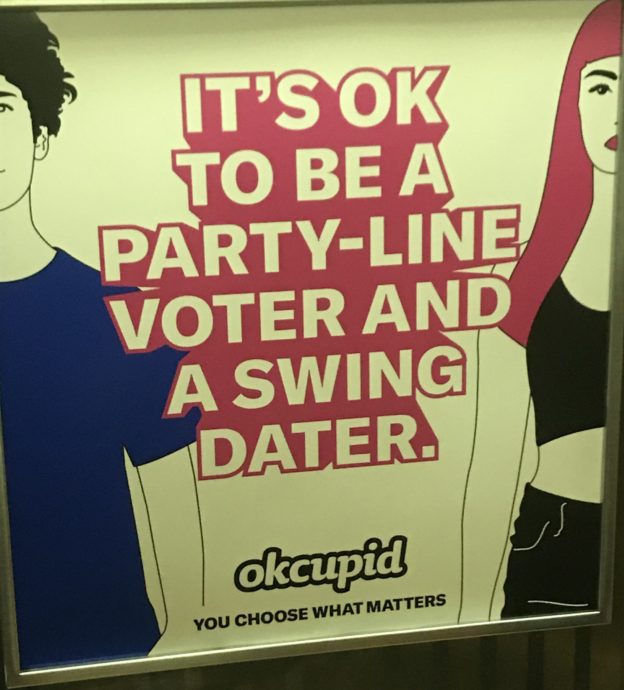
OK Cupid ad showing a masculine figure in a blue shirt and a feminine figure with pink hair, with text reading "Its ok to be a party-line voter and a swing dater."

2/24 (Monday): Playing with Genre, Style, and Audience Day 1

OK Cupid ad showing a masculine figure in a blue shirt and a feminine figure with pink hair, with text reading "Its ok to be a party-line voter and a swing dater." Writing Into The Day (15 minutes)

  1. What argument(s) is this ad making?
  2. What does “swing dater” mean in this context and how do you know?
  3. Who is the intended audience? Why/how do you know?
  4. What strategies is it using to persuade the audience?
  5. Is the ad effective? Why or why not?


Discussion

Overview:

  1. Reminders and Check-In
  2. Writing Activity From 1512!!! (from Professor Desiderius Erasmus)
  3. Writing Activity From 2020 (from me)
  4. Looking Ahead

Reminders and Check-In

  1. Spring Start Workshops!!!
  2. Survey for peer review part 2
  3. New set of rhetorical devices (Fear and Humor Appeals)

Writing Activity from Prof. Desiderius Erasmus (1466-1536)

Erasmus: Medieval scholar who did a lot of translating of the Bible and Islamic philosophy. Wrote De Copia, which is literally the book “on style.”

Your Task (10 minutes):

Rewrite the following sentence in as many different ways as possible:
Your letter pleased me greatly.

Discussion/Creation of Group List

Erasmus Link (Please don’t look at this link before we do the activity!!)

Writing Activity 2 (from me)


Looking Ahead

February 26 (Wednesday): Writing Workshop

Assignments Due
Fear and Humor Appeal Examples
“This I No Longer Believe” Full First Draft Due by the start of class time!!!


2/19 (Wednesday): Writing Workshop 1

  1.  Please grab your name plate as you come in
  2. If you have not already done so, fill out the peer review survey here: https://tinyurl.com/vfbtqr3
  3. And upload your draft to the submission link on Blackboard.

Writing Into the Day

  1. What have you accomplished so far in your drafting process?
  2. What questions, difficulties, or “sticky spots” are you having?
  3. Where do you see your draft going in the future?
  4. What aspects of your writing would you like feedback on at this stage? What aspects do you NOT want feedback on at this stage?
  5. If you have participated in peer review in the past, what was helpful, what was unhelpful, and why?

If you are participating in online feedback and would like to anonymously share the answers to 2 and 4 with your reviewers, please email them to me so I can add them to the corresponding post. 

Overview:

  1. Reminders and Review
  2. Discussing peer review practices
  3. Sorting people who didn’t fill out the survey into feedback groups
  4. Peer review!
  5. Looking Ahead

Reminders and Review

  1. Spring Start– less than half of you attended the first workshop!!!
  2. How to Post refresher
  3. Several past assignments now that you can still do late for partial credit
  4. Post your own optional posts to the blog!

Group Sorting

If you opted for in-person peer review with discussion:

You are in a group together.

If you opted for private feedback from me OR anonymous online feedback:

You will all be commenting on the drafts posted anonymously to the blog.

Leave comments on as many of the drafts as you have time for, but I would rather you spend time leaving thoughtful, detailed feedback on one draft rather than speed through multiple drafts. (Note: In-line comments feature is available!)

If you opted for anonymous in-person peer review:

Please choose whether you would prefer online anonymous feedback or to join the not-anonymous group. Not enough people chose this option for them to remain anonymous while also giving/receiving feedback in real life.

If you still have not chosen an option but do have a draft ready for today:

Choose an option now and either email me your draft so I can put it on the blog anonymously or join up with others who would like in-person discussion.

If you did not choose an option and have no draft ready for today:

Please leave feedback for your classmates online.

Peer Review Guidelines:

I will keep a timer running so we can try to distribute our feedback evenly/make sure everyone gets comments.

Here are some questions for you to think about as you write your responses to your peers.

  1. Summarize the journey the writer is conveying and the major steps along that journey/their significance for the writer. Writers: Do these summaries match what you were trying to express?
  2. Make a comment on some vivid imagery or specific details that you found moving/powerful/effective
  3. Make a comment on some imagery or details that you want to know more about, or you think could be made more specific/evocative
  4. What questions do you have as a reader? (This can be things you found vague/confusing or just things you want to know more about)
  5. Where is the “center of gravity” of this draft so far? (That is, what seems to be the most important part?)
  6. Look back at the rubric/assignment sheet. Do you think there are any specific areas of the rubric the writer could improve on?
  7. If the writer has provided specific questions they would like feedback on, please try to address those.

Looking Ahead:

February 24 (Monday): Playing with Genre, Style, and Audience Day 1

Readings Due
“The Fear Appeal”
“The Humor Appeal”

February 26 (Wednesday): Writing Workshop 2

Assignments Due
Fear and Humor Appeal Examples (comment on post on blog)
“This I No Longer Believe” Full First Draft Due

2/10 (Monday): Beginning Creative Nonfiction

Writing Into the Day (15 min):

Tell the story of your commute to class today, using specific details/imagery. Rather than just describing the route you took, share with us the things you noticed, what those things mean to you, how you felt. Help us envision what it was like to be you.

A Bad Example: I was at the Graduate Center before this, so I walked to Herald Square and took the B train to Columbus Circle and then walked here, picking up a latte on the way. Then I worked in my office for a little bit and then I took the elevator downstairs to come to class.

A Better Example: After my student committee meeting, I left the English department lounge and headed for the elevators. Downstairs, I take my Metro Card out of my wallet in the lobby and then step out into the damp February air. Fuck. I forgot it was going to rain today. Back into the lobby, drop my backpack, take out my umbrella. Back outside. Wish I’d worn a scarf. The homeless man who often sits at the top of the subway entrance with his mirror and basket isn’t here today– I hope he’s somewhere dry. An opera singer is performing on the mezzanine. She’s very good, but I like the man with the didgeridoo better… (And so on)

Sharing?

Overview:

  • Logistical check-in — Are you facing any technical problems or confusions with navigating the Course Site/ course requirements?
  • Spring Start check-in
  • Reading and annotating example of Creative Nonfiction
  • Generate list of guidelines for What Makes This Good?
  • Go over assignment sheet for Paper 1, discuss how we may want to revise the rubric

Looking Ahead:

Wednesday, February 12: NO CLASS

3 readings to do (but I may cancel one of them):

Weapons of Math Destruction: Chapter 3 (PDF)
Article on College Rankings
SAT selling student info

Monday, February 17: NO CLASS

Weapons of Math Destruction Blog Assignment Due (instructions will be posted soon)

Wednesday, February 19

Readings Due
“Shitty First Drafts”

Assignments Due
“This I No Longer Believe” Partial Draft Due


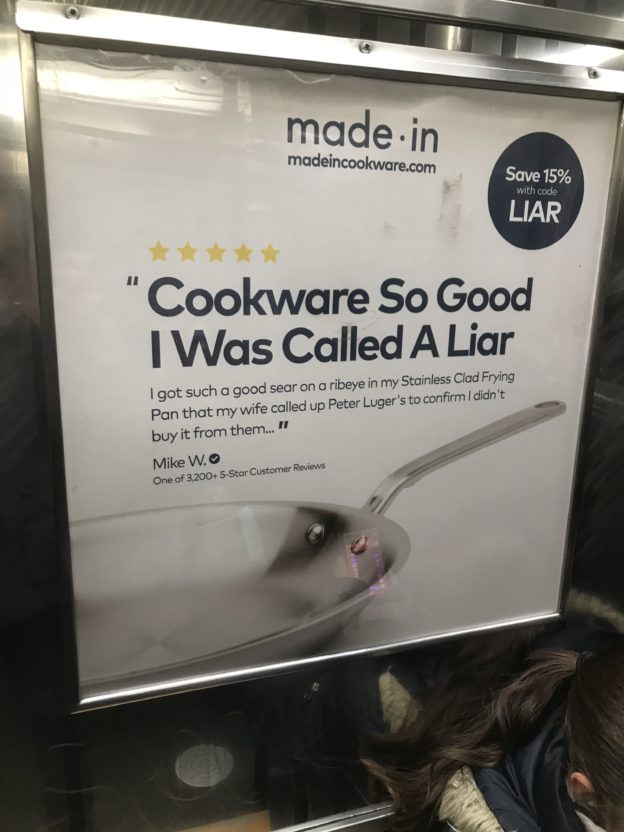
Subway ad for cookware, quoting a 5 star review saying "Cookware So Good I Was Called a Liar."

Wednesday (2/5): WordPress Training + Beginning Portfolios

Subway ad for cookware, quoting a 5 star review saying "Cookware So Good I Was Called a Liar."

Writing Into the Day (15 min):

Please analyze this ad rhetorically, using whatever previous rhetorical knowledge you have, plus what we have read about together. If you don’t have any previous rhetorical knowledge, that’s okay!

Some guiding questions:

What argument(s) is the ad making?
Who seems to be the intended audience?
What strategies are they using to convince the audience?
Do you think the data presented is reliable? Why or why not?
Do you think the ad is effective? Why or why not?
How does this compare to the Brooklinen ad from Monday?

Discussion

Agenda:

  1. Making Commons accounts + joining Course Group/Site
  2. Signing up for Spring Start Workshops
  3. Discussing portfolio + looking at examples
  4. Creating own portfolio skeletons
  5. Our first posts! (Group work + WordPress Practice)

Links for Commons:

Register for an Account
Course Group

Links for Spring Start:

Descriptions of Workshops
Sign-Up Link

Portfolio Instructions and Examples:

I haven’t revised my full portfolio instructions from last year yet, but there are 8 required assignments that the English department mandates you include in your portfolios.
I will also ask you to write a few other short reflections on your work in the course and include them in your portfolio. If you do not complete any of the required assignments, you will receive a 0 for that assignment AND not earn those points on the portfolio rubric, so the Big 8 are especially important!!

You will be making your own CUNY Commons sites for your portfolios, which will give you experience using WordPress– the platform that powers almost a third of the entire Internet!

Here are some examples of student portfolios from last semester:

America’s Portfolio
Elidhet’s Portfolio
Lised’s Portfolio

Each student designed and organized their portfolio in different ways, but all of them did a great job!

Instructions for First Posts:

As a group, choose a piece of media (written, visual, video, music, some combination) that you think is particularly powerful, emotionally moving, or intellectually persuasive. Then write a post together (using any one group member’s Commons account) on our site summarizing the piece of media and explaining what specific features help make it so effective. (This can just be a paragraph)

As you write your post, make sure you:

  • Title the post
  • Credit all group members in the post
  • Select appropriate Categories for your post (“Posts” and “Student Posts”)
  • Add any appropriate Tags to your post (your choice)
  • Add any relevant Links (if any)
  • If your chosen piece of media is something you can Embed (in addition to providing a link), use the Add Media and/or Add Document feature. If it is a YouTube video, find and paste in YouTube’s Embed HTML Code.
  • Use the “Preview” feature to double check your post looks how you want it to look
  • Click the blue “publish” button when you’re done!

Looking Ahead:

Monday: Beginning Paper 1 (Creative Nonfiction– This I No Longer Believe)

Readings Due:
“Weapons of Math Destruction Chapter 1” (PDF)
“The Data Driven Life” (link)

Assignments Due: None!


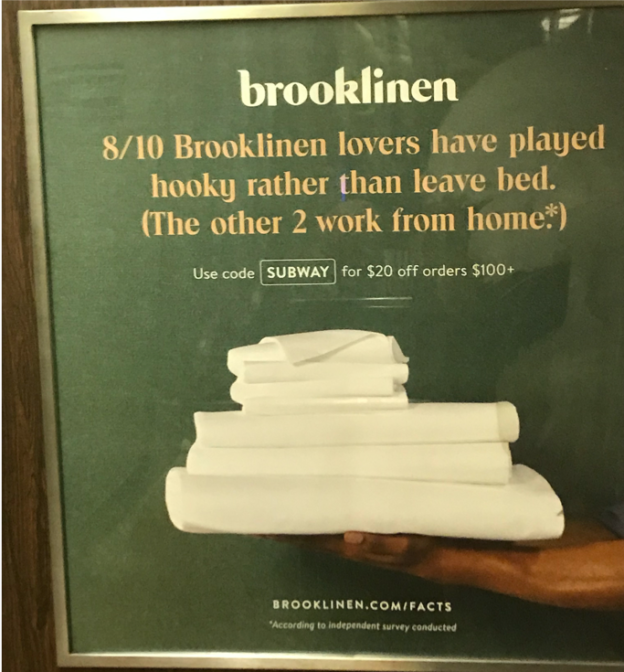
Subway ad for Brooklinen

Monday 2/3: Principles of Academic Writing

Subway ad for Brooklinen

Writing Into the Day (15 min):

Please analyze this ad rhetorically, using whatever previous rhetorical knowledge you have, plus what we have read about together. If you don’t have any previous rhetorical knowledge, that’s okay!

Some guiding questions:

What argument(s) is Brooklinen making?
Who seems to be the intended audience?
What strategies are they using to convince the audience?
Do you think the data presented is reliable? Why or why not?
Do you think the ad is effective? Why or why not?

Discussion

 Outline:

  • Bandwagon + Namecalling
  • The Academic Rhetorical Situation
    • How to sound professional
    • Formal
    • Scientific
    • “Opposite of how you speak” — no slang
    • Speech is casual, we don’t want to sound that way
    • We won’t be taken seriously
    • Job interviews, business professionals
    • You want your point to be trusted/well-received
    • Professors!!!
    • Students + colleagues
  • General Rules for Formal Academic Writing
    • Use citations
    • No contractions
    • Structure– clear, ordering your ideas in an intentional way
    • Introduction, Conclusion
    • Formal tone, no slang
    • An academic formatting style (MLA, APA, etc.)
    • Third person (no first person, no second person)
    • Works cited/bibliography
    • Grammar + punctuation— “appropriate”
    • adding too many commas
    • Run on sentence (don’t)
    • Passive voice

I added 8 ml of water to the beaker

The researcher added 8ml of water to the beaker

One should add 8ml of water to the beaker

 Looking Ahead:

**Meet in Computer Lab 7.68 for WordPress Training + Portfolio Discussion**

Readings Due Wednesday: None!

Assignments Due Wednesday: Bandwagon and Namecalling Examples (comment on blog post)


Wednesday 1/29: Introduction to Major Concepts

**Please grab your name tent from the table by the door**

**If you were not here on Monday, please grab a piece of paper to make a name tent and a copy of the course schedule**

Writing Into the Day (10 min)

When has a piece of writing, either something you wrote or something you read, made a significant impact on your life? What qualities or context made that piece of writing so significant?

Sharing (5 min)

Overview:

  • What is Rhetoric?
  • Introducing Rhetorical Devices Assignment
  • What are WMDs? Why are they important?
  • Questions we have about either topic
  • Previewing next week

What is Rhetoric?

  • Collective brainstorm of prior associations/meanings
    • tool to help you write an essay
    • a way to get your point across
    • a way to make your speech better, better = more informative and not boring
    • a way to reach your audience
    • to make an emotional connection with the audience
    • to persuade somebody
    • “empty rhetoric”
  • Main ideas from the reading
    • Writing is not an inherent talent– it is a skill that can be studied/learned/improved through rhetoric
  • 4 Purposes of Rhetoric
    • To persuade
      • Having a strong argument– running for office, being a lawyer
      • Bring up/address counter arguments
      • Use quotes that are relevant — on topic, accurate, who is it from?
    • To inform
      • Enunciate, be clear
      • Use facts, back up your opinions with evidence
      • Having data (reliable data!)
      • Use simple/easy to understand language
      • The news
      • Teaching! Student presenting on topic (teaching!)
    • To express
      • Getting your ideas to shine, have your ideas stand out, stick with people
      • Know your situation– use appropriate tone
      • Use emotions and details– emphasize the important parts
      • Be respectful– or deliberately disrespectful
      • Giving personal examples (either from yourself or from someone else)
      • Giving a eulogy– you’re not trying to persuade people that the person was good/bad, you’re just talking about their life
    • To entertain
      • To not be offensive (or to be deliberately offensive)
      • Turn dark humor into comedy
      • Choose your level of seriousness appropriately
      • Volume
      • Tone
      • Variety
      • Comedic timing
      • Read your audience– what kinds of things are they entertained by?
      • To invoke emotion
      • Fiction more often than nonfiction — build suspense
      • Keeping audience’s attention– cliffhangers, surprises, plot twists, dynamicness,
      • Know when to stop
      • Hanging out with your friends
  • Work together in pairs to come up with general rhetorical rules for each Purpose of Rhetoric
  • Then also come up with some situations in which each purpose might be useful/important

Sharing/Compiling

Discussing Rhetorical Devices Assignment

What Are WMDs?

  • Share out main ideas from the TED Talk
    • The way they grade teachers– the algorithm doesn’t actually measure whether someone is a good teacher, and people are losing their jobs because of it
    • We are being scored by secret formulas
    • Different people get different sentences for the same/similar crimes because of the algorithm used to determine sentences
    • Algorithms are never going to be fair if we don’t make them fair
      • Question them
      • Algorithmic audit– check the data, check the definition of success that is programmed into the algorithm
      • Who does it fail?
      • Be open to feedback, always work to improve the algorithm
    • Consider longterm effects
    • Algorithms can be used to reinforce segregation
      • Prison algorithms are racially biased
      • Different policing of different areas
      • Where is the data coming from????
    • Data scientists should be translators of ethical conversations that happen in the world
      • Data scientists should explain to others when we can trust data and for what
      • Most people are mystified by statistics!
  • Create beginning working definitions
  • When do we already know we encounter algorithms in our day to day lives?
  • Preview Table of Contents from the book

Questions? (either to answer now or to be thinking about /discussing in the future)

If We Have Leftover Time: How do we want to do political issues this semester?

Previewing Next Week:

Monday (2/3): Introduction to Propaganda + Principles of Academic Writing

Readings Due:

“Propaganda is Everywhere”

“Name Calling”

Bandwagon Illustration

Bandwagon Description

Assignments Due:

None!

Wednesday (2/5): WordPress Training and Portfolio Discussion

 Meet in 7th Floor Computer Lab (NB 7.68)

Readings Due:

None!

Assignments Due:

Your first rhetorical devices assignment! Post examples + analysis of the “namecalling” and “bandwagon” techniques as comments on the blog.

Monday (1/27): Introductions to Each Other and the Course

Bitmoji of Olivia waving and holding a backpack, with a chalkboard that says "Back to School!"

Each day, either shortly before class or shortly after, I will post the lesson plan for the class period here. This way, you will be able to catch up on anything you miss due to being absent or late, and review what we’ve discussed. You can also use these posts to access any links we use during class.

Writing into the Day (10 mins)

On a piece of paper or an electronic device, please freewrite on the following:

  1. What information do you want to know in order to plan for success in this course?
  2. What questions do you have about this class?
  3. What are your existing strengths as a writer?
  4. What areas would you like to grow in this semester?

Today’s Outline:

  • Overview Prezi
  • Introducing ourselves
  • Answering our questions (#1 and #2)
  • Course site/syllabus/course calendar
  • Previewing next week

Introductions

  • Your name/pronouns
  • Your major and/or interests
  • A fact about you that isn’t true about anyone else in the room

Sharing Responses to WitD (5 min)

Syllabus (Up to last 15 minutes)

  • Course group and site
  • Walk/talk through syllabus
  • Summarize course calendar

For Wednesday: